
BPN14770 is supplied by Rexar as a research-grade chemical reference material for analytical chemistry, compound identification and laboratory comparison workflows. Also known as Zatolmilast or BPN-14770, this substituted pyridine-containing aromatic carboxylic acid incorporates chlorophenyl, trifluoromethyl, pyridine and phenylacetic acid structural features and is provided exclusively for controlled research environments requiring verified chemical identity, consistent structural documentation and reproducible analytical comparison.
Research-grade material distributed by Rexar within the European Union.
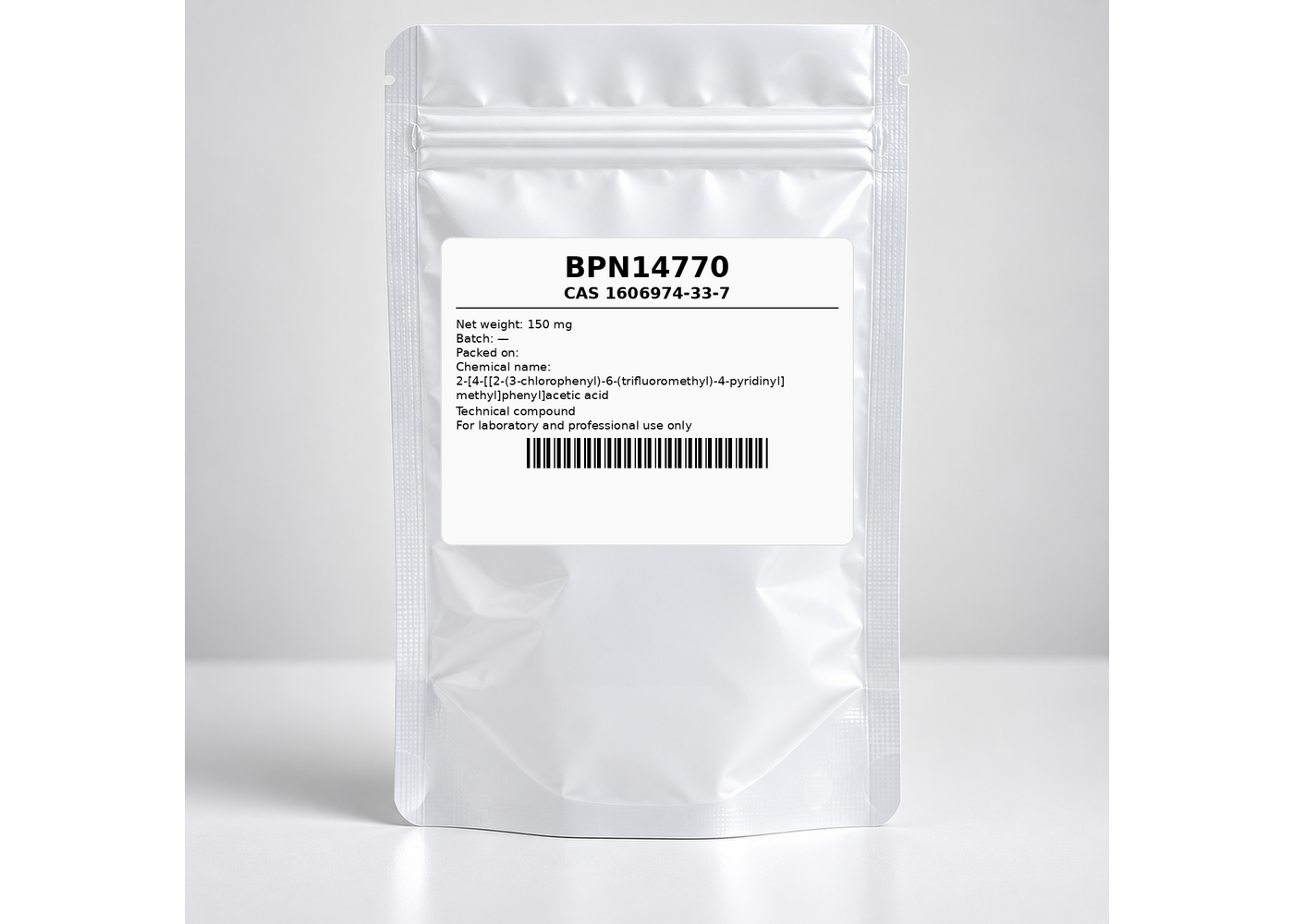
BPN14770 (CAS 1606974-33-7) is supplied in sealed laboratory packaging to support traceability, storage integrity and laboratory handling procedures.
Rexar Technical Compound Datasheet (PDF)
Molecular structure data and selected physicochemical properties can be consulted via: BPN14770 (Zatolmilast) on PubChem
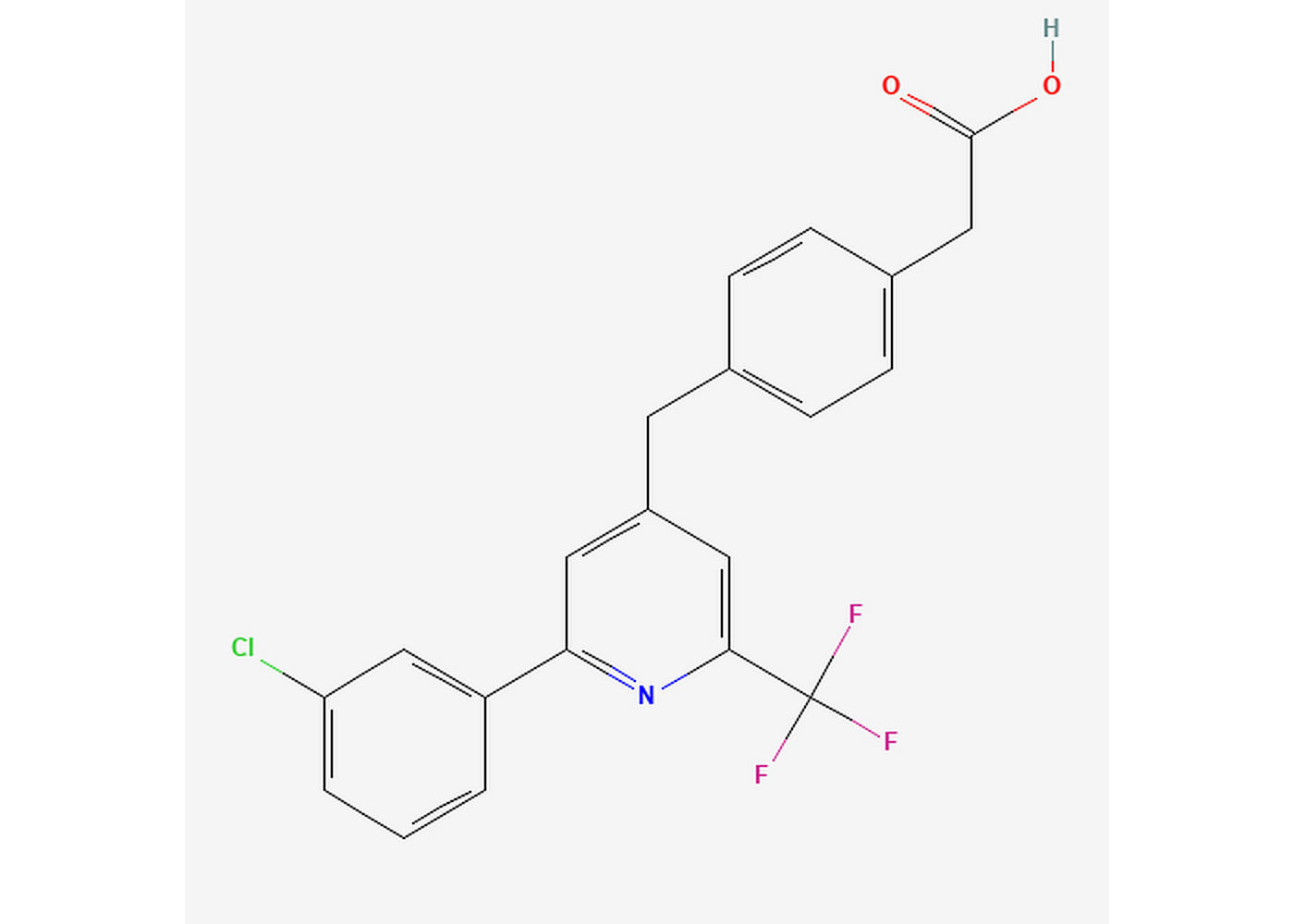
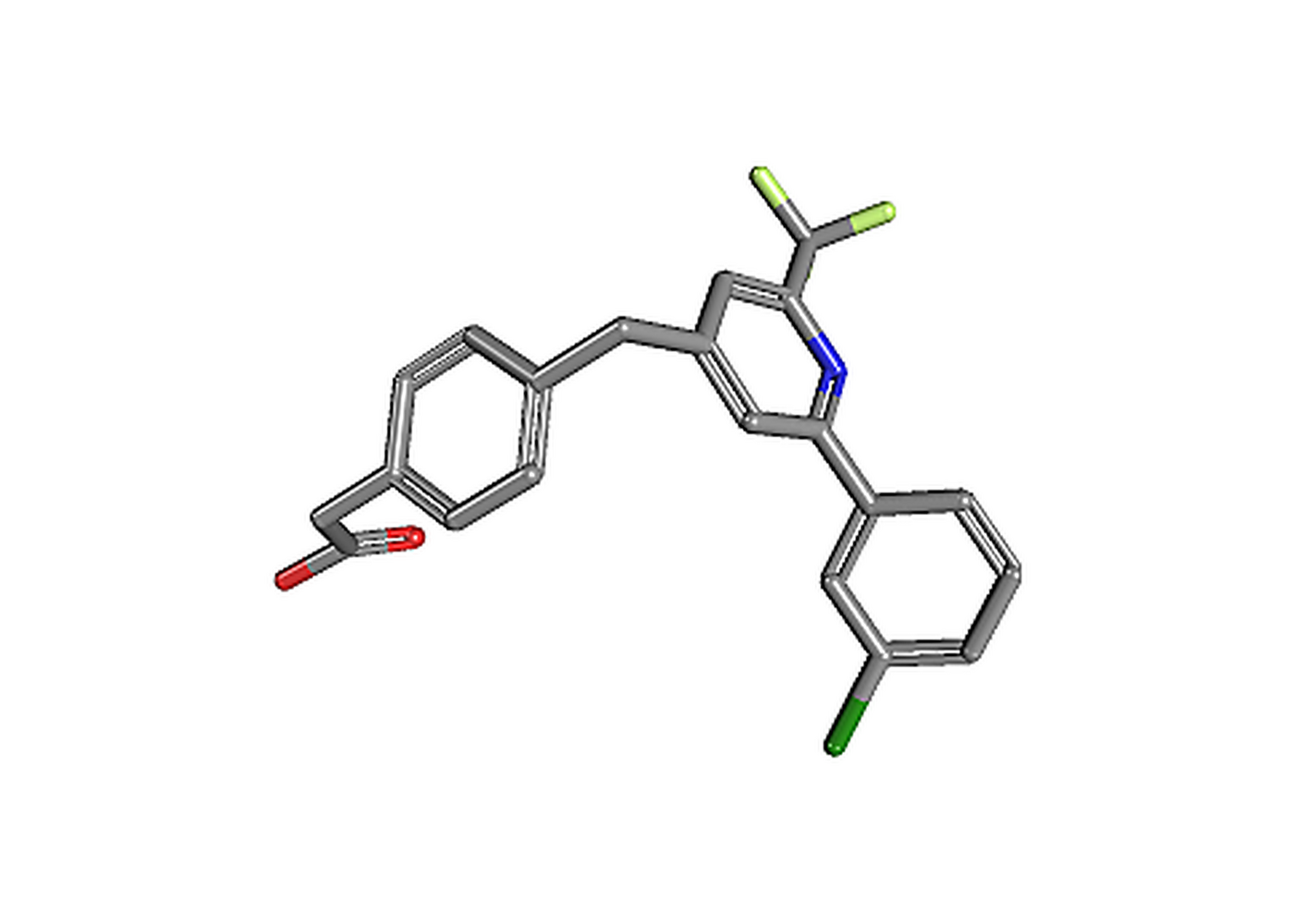
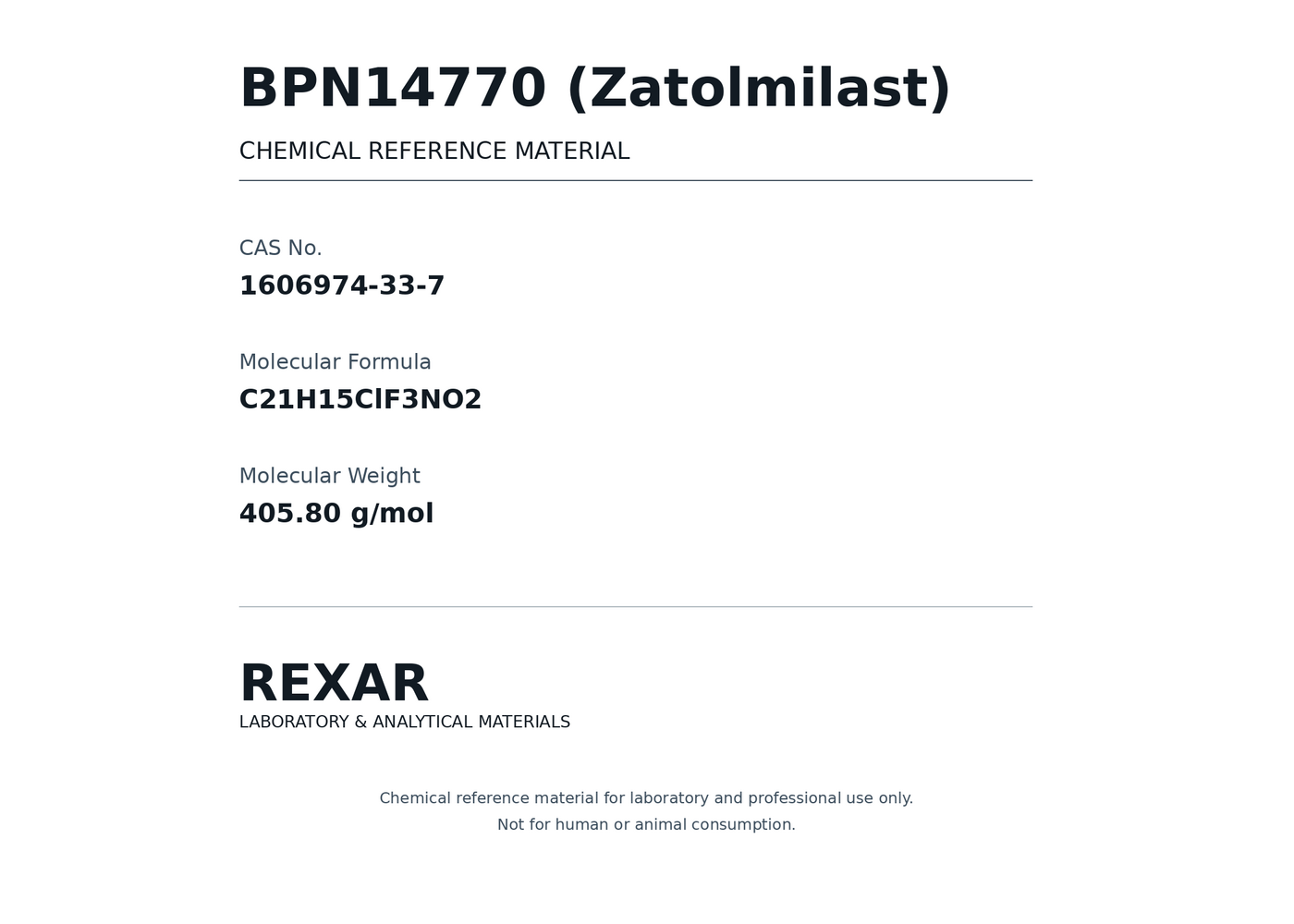
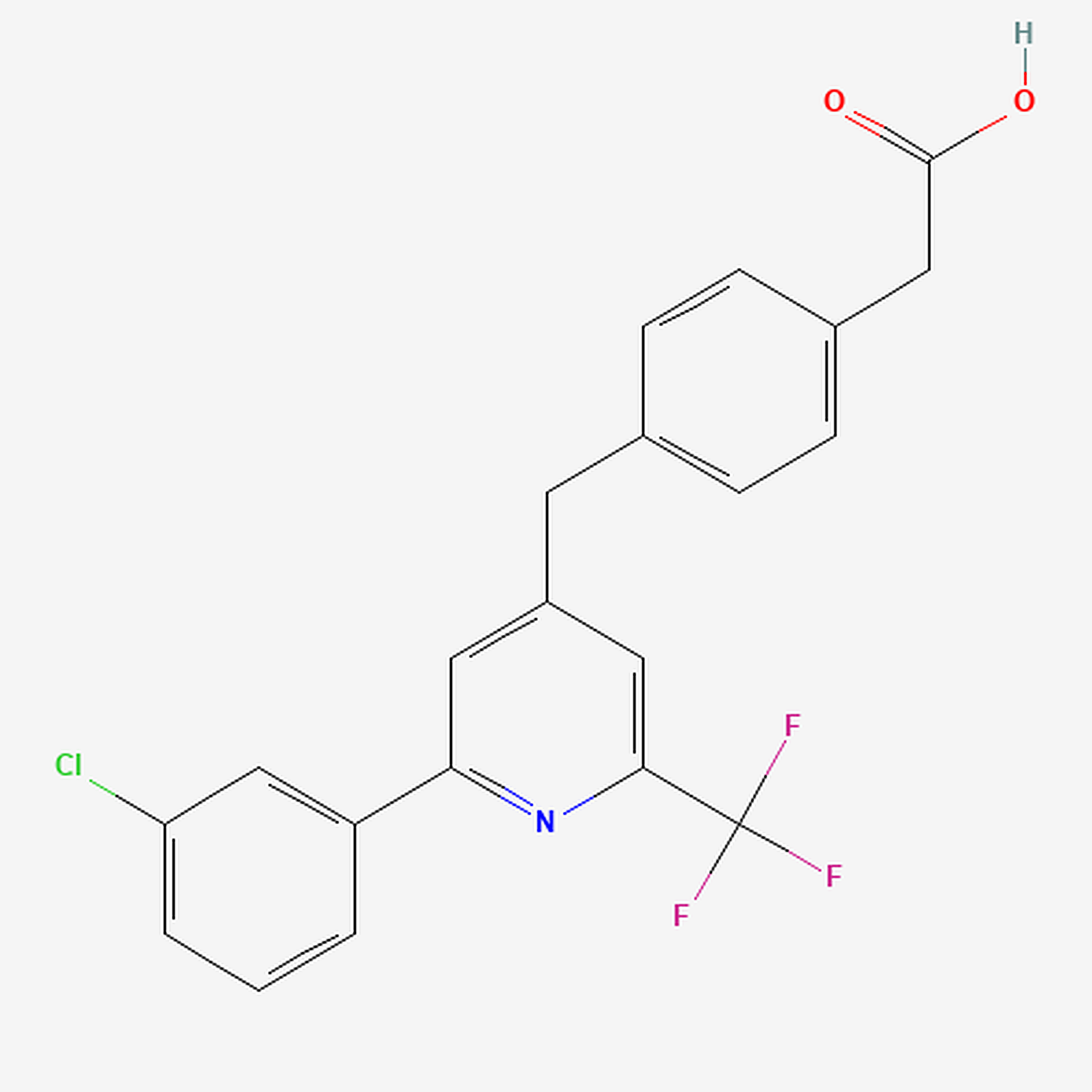
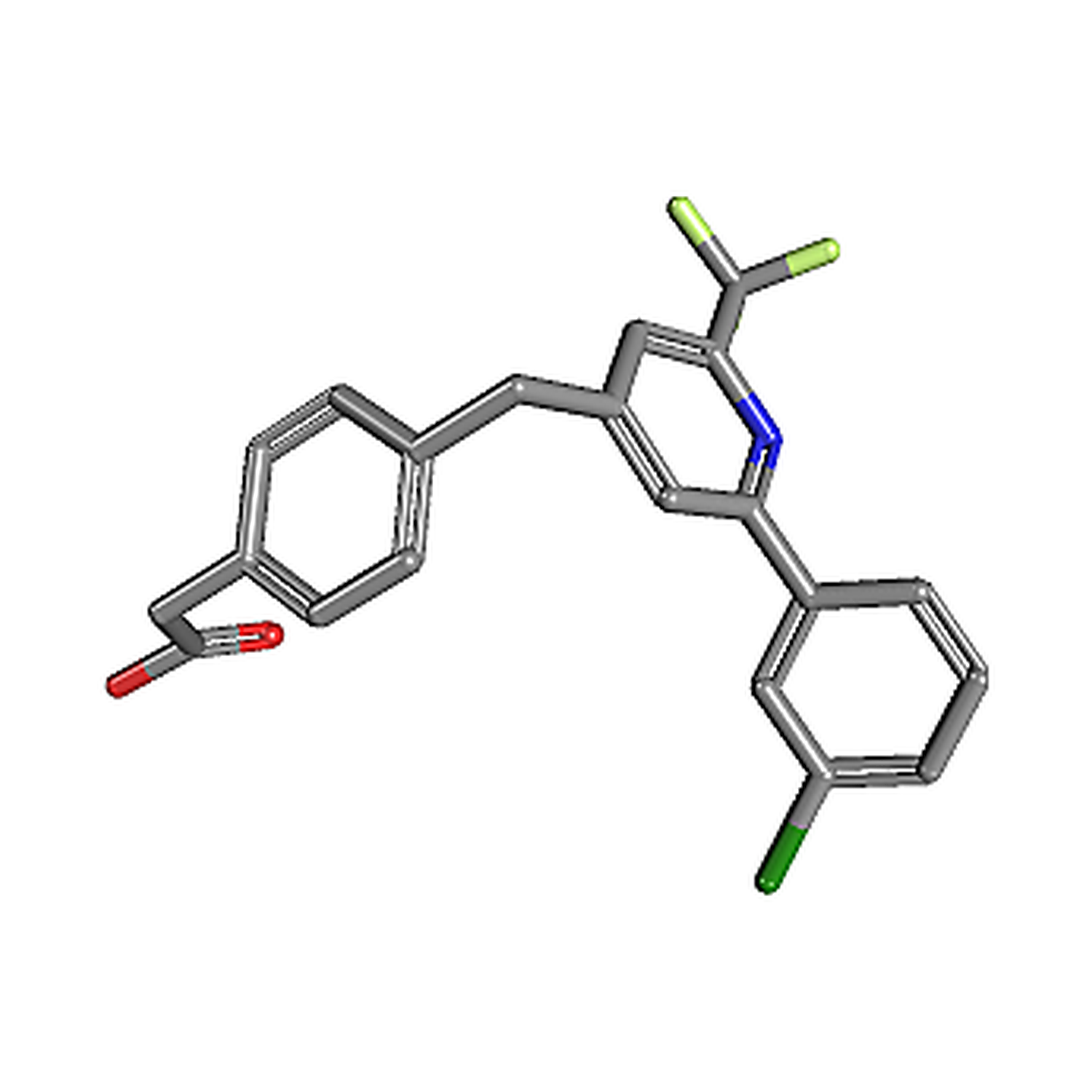
BPN14770 is a synthetic organic compound with the molecular formula C21H15ClF3NO2. Its molecular architecture combines a substituted pyridine ring, a chlorophenyl aromatic region, a trifluoromethyl group and a phenylacetic acid structural region connected through a methylene-containing linkage.
The structure contains one chlorine atom, three fluorine atoms, one nitrogen atom and two oxygen atoms distributed across chemically distinct functional environments. This combination provides a structurally differentiated small-molecule framework suitable for chromatographic, mass-spectrometric and spectroscopic characterisation.
A defining structural element of BPN14770 is its substituted pyridine ring. This six-membered aromatic heterocycle contains one nitrogen atom and carries several structurally distinct substituents.
The pyridine framework contributes a characteristic nitrogen-containing aromatic environment and provides analytical features relevant to chromatography, mass spectrometry, NMR spectroscopy and comparative compound identification.
BPN14770 contains a phenylacetic acid region consisting of an aromatic phenyl ring connected to an acetic acid functionality. This portion contributes one of the principal polar structural regions of the molecule.
The carboxylic acid functionality provides hydrogen-bond donor and acceptor characteristics and may produce characteristic carbonyl and hydroxyl-associated features during infrared and NMR analysis.
The molecular formula C21H15ClF3NO2 reflects a structure containing carbon, hydrogen, chlorine, fluorine, nitrogen and oxygen distributed across several chemically distinct functional groups.
The combination of aromatic, heterocyclic, halogenated and carboxylic-acid structural elements provides multiple analytical markers for comparative compound identification.
BPN14770 contains a carboxylic acid group associated with the phenylacetic acid portion of the molecule. This functionality contributes significantly to molecular polarity and hydrogen-bonding behaviour.
The carboxyl group contains both carbonyl and hydroxyl environments and may provide characteristic analytical signals during infrared, NMR and mass-spectrometric analysis.
A trifluoromethyl group is attached to the substituted pyridine region of BPN14770. This group contains three fluorine atoms bonded to a single carbon atom and represents a distinctive halogenated structural feature.
The trifluoromethyl group influences molecular mass, electronic distribution and lipophilic character and can provide useful analytical differentiation from structurally related compounds lacking fluorinated substitution.
BPN14770 contains one chlorine substituent positioned on a phenyl-derived aromatic region. Chlorine substitution influences molecular mass, electronic distribution and hydrophobic character.
The presence of chlorine also contributes characteristic isotope behaviour that may assist interpretation during mass-spectrometric analysis.
The pyridine portion of BPN14770 contains one ring nitrogen atom incorporated directly into the aromatic heterocyclic system.
This nitrogen-containing environment contributes to molecular polarity and may influence chromatographic retention, protonation behaviour and mass-spectrometric response under different analytical conditions.
The three fluorine atoms of BPN14770 are concentrated within the trifluoromethyl substituent. Carbon-fluorine bonds provide a chemically distinctive environment compared with non-fluorinated aromatic substituents.
This fluorinated region can influence electronic properties, chromatographic behaviour and spectroscopic characteristics and may provide an additional structural marker during comparative analysis.
BPN14770 contains hydrogen-bond donor and acceptor sites arising primarily from the carboxylic acid functionality and the pyridine nitrogen atom.
The distribution of these sites may affect solvation, solid-state interactions, chromatographic behaviour and interactions with polar analytical stationary phases.
The molecule combines a polar carboxylic acid functionality and a nitrogen-containing heterocycle with chlorinated and fluorinated aromatic structural regions. This creates a balance between polar and less polar molecular domains.
This mixed structural character is relevant when evaluating solvent selection, mobile-phase composition and sample preparation for analytical workflows.
The aromatic phenyl and pyridine regions of BPN14770 provide relatively rigid structural elements, while methylene-containing connections introduce rotational flexibility between portions of the molecular framework.
No defined stereogenic centre is present in the standard molecular representation, and the compound is represented without specified stereochemistry.
Under liquid chromatographic conditions, retention may be influenced by the aromatic ring systems, carboxylic acid functionality, pyridine nitrogen, chlorine substituent, trifluoromethyl group and overall molecular polarity.
Retention time and peak shape may vary according to mobile-phase composition, pH, stationary-phase chemistry, temperature and sample concentration.
LC-based methods may be used for qualitative identity comparison, purity profiling and retention-time verification of BPN14770 reference material.
The combination of aromatic regions, a carboxylic acid functionality and halogenated substituents may require optimisation of mobile-phase composition and stationary-phase chemistry to obtain suitable retention and peak symmetry.
With a molecular weight of approximately 405.8 g/mol, BPN14770 falls within a mass range suitable for routine LC-MS analysis. Appropriate ionisation techniques may support detection of protonated, deprotonated or adducted molecular species depending on solvent composition, mobile-phase conditions and instrument parameters.
The chlorine-containing region may contribute characteristic isotope features, while fragmentation may involve the carboxylic acid region, methylene linkages, substituted pyridine framework or aromatic portions of the molecule and can support structural confirmation when compared with authenticated reference data.
Proton NMR analysis may show characteristic resonances associated with aromatic proton environments, methylene groups and the carboxylic acid proton under suitable analytical conditions.
Carbon NMR analysis may provide distinguishable signals corresponding to aromatic carbons, pyridine-associated carbon environments, methylene carbons, the trifluoromethyl-associated carbon and the carboxyl carbon.
Infrared analysis may reveal characteristic absorption features associated with the carboxylic acid carbonyl, O-H functionality, aromatic C-H environments and the broader substituted aromatic molecular framework.
The carboxylic acid functionality can provide prominent absorption characteristics that may assist structural comparison when evaluated against an authenticated reference spectrum.
BPN14770 contains both chlorine and fluorine as halogen elements. The chlorine atom may provide characteristic isotopic features during mass-spectrometric analysis, while the trifluoromethyl group contributes a distinctive fluorinated structural environment.
These halogenated substituents also influence molecular mass, electronic distribution and lipophilic character within the molecule.
The multiple aromatic and heteroaromatic structural regions of BPN14770 may support ultraviolet-based chromatographic detection. Suitable detection wavelengths should be selected according to measured absorbance characteristics and validated laboratory methods.
Substitution by chlorine, trifluoromethyl, carboxylic acid and pyridine-containing groups may influence the precise absorption profile of the compound.
BPN14770 is supplied as a laboratory powder. Solid-state characteristics such as crystallinity, particle morphology, residual moisture and residual solvent content may depend on manufacturing and purification procedures.
Analytical laboratories may use melting behaviour, powder analysis or spectroscopic comparison as supplementary identity indicators where appropriate.
BPN14770 may serve as a qualitative reference compound in structural verification and comparative analytical workflows involving LC-MS, HPLC, NMR and infrared spectroscopy. Laboratory procedures may include retention-time comparison, molecular-weight confirmation and comparative spectral profiling.
BPN14770 can be structurally described as a substituted pyridine-containing aromatic carboxylic acid incorporating chlorophenyl and trifluoromethyl structural features.
Its molecular architecture provides several distinct structural markers, including a pyridine nitrogen, a carboxylic acid functionality, chlorine substitution and a trifluoromethyl group, which can support comparative analytical identification.
The substituted pyridine core contains a six-membered aromatic heterocycle incorporating one nitrogen atom. The ring is connected to chlorophenyl, trifluoromethyl and methylene-linked aromatic structural regions.
This heteroaromatic core contributes characteristic nitrogen- and carbon-associated environments that may assist analytical identification.
BPN14770 contains a chlorophenyl-derived structural region in which chlorine substitution creates a distinct aromatic environment. This region is directly connected to the substituted pyridine ring.
The chlorophenyl element provides a halogenated aromatic marker that may support chromatographic and spectroscopic differentiation from related compounds.
The pyridine ring of BPN14770 carries a trifluoromethyl substituent containing three fluorine atoms. This highly fluorinated structural feature contributes substantially to the compound’s elemental composition and molecular mass.
The trifluoromethyl group also creates a distinctive electronic environment that can influence chromatographic and spectroscopic characteristics.
BPN14770 contains one carboxylic acid functionality within its phenylacetic acid structural region. This group contains two oxygen atoms in chemically distinct carbonyl and hydroxyl environments.
The carboxyl functionality contributes significantly to molecular polarity and provides distinct analytical features during infrared, NMR and mass-spectrometric analysis.
The carboxylic acid functionality and pyridine nitrogen of BPN14770 may influence protonation, deprotonation and ionisation behaviour under different analytical conditions.
Mobile-phase pH, solvent composition and ionisation parameters can therefore affect chromatographic retention and mass-spectrometric response.
The molecular formula C21H15ClF3NO2 contains one chlorine atom in an aromatic structural region, three fluorine atoms within a trifluoromethyl group, one nitrogen atom within the pyridine ring and two oxygen atoms within the carboxylic acid functionality.
Theoretical elemental composition may support identity verification when combined with mass spectrometry and spectroscopic analysis.
As a chemical reference material, BPN14770 may be used for qualitative structural comparison, method development and analytical identity verification in laboratories examining substituted heteroaromatic compounds, halogenated aromatic structures or pyridine-containing reference materials.
Analytical reproducibility depends on consistent sample preparation, validated instrument parameters, suitable reference documentation and controlled storage conditions.
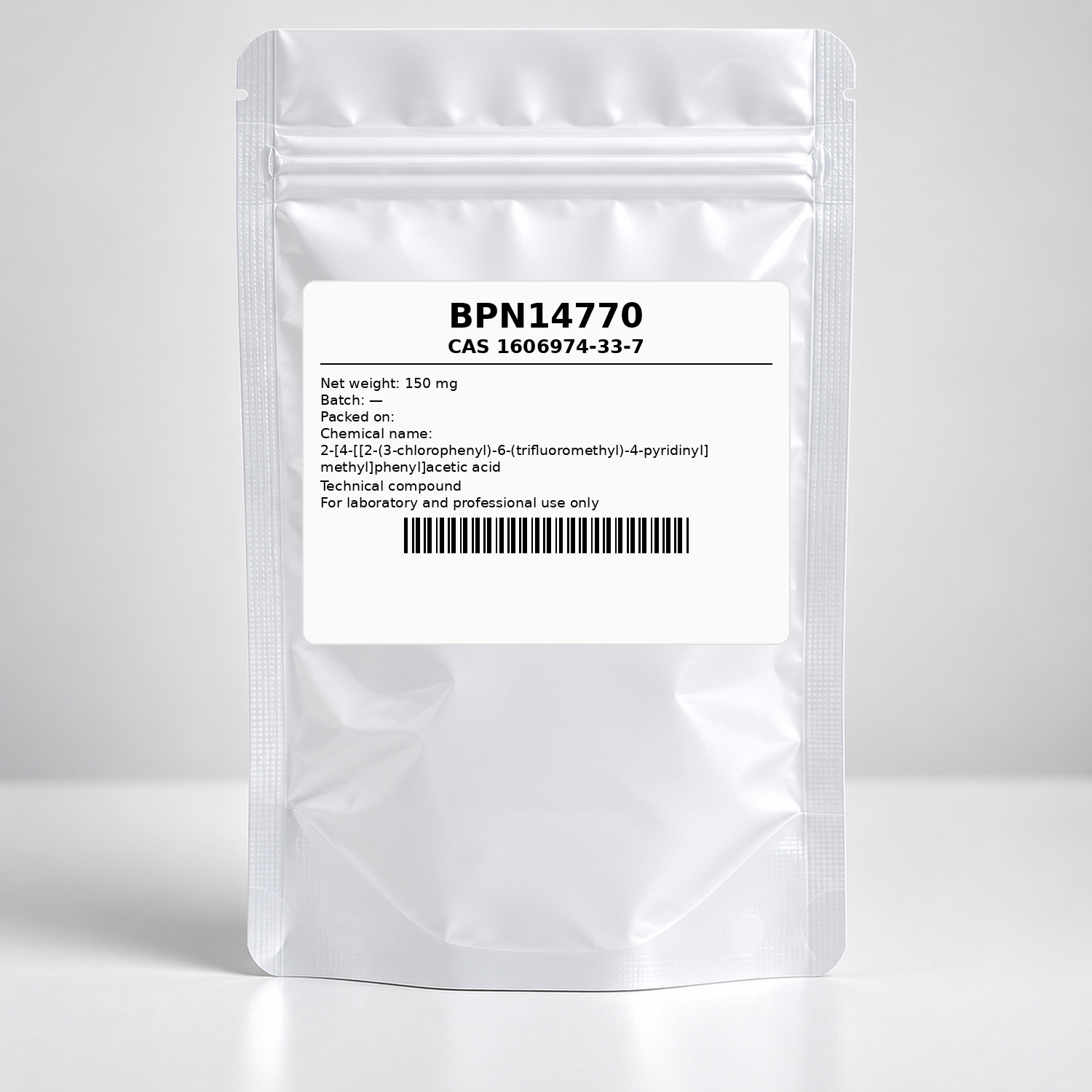
Each unit is supplied in sealed laboratory packaging designed to support material integrity during storage and transport. Batch identification labelling supports traceability and internal documentation within controlled research environments.
Packaging should remain closed when the material is not in use and should be protected from moisture, excessive heat and direct light.
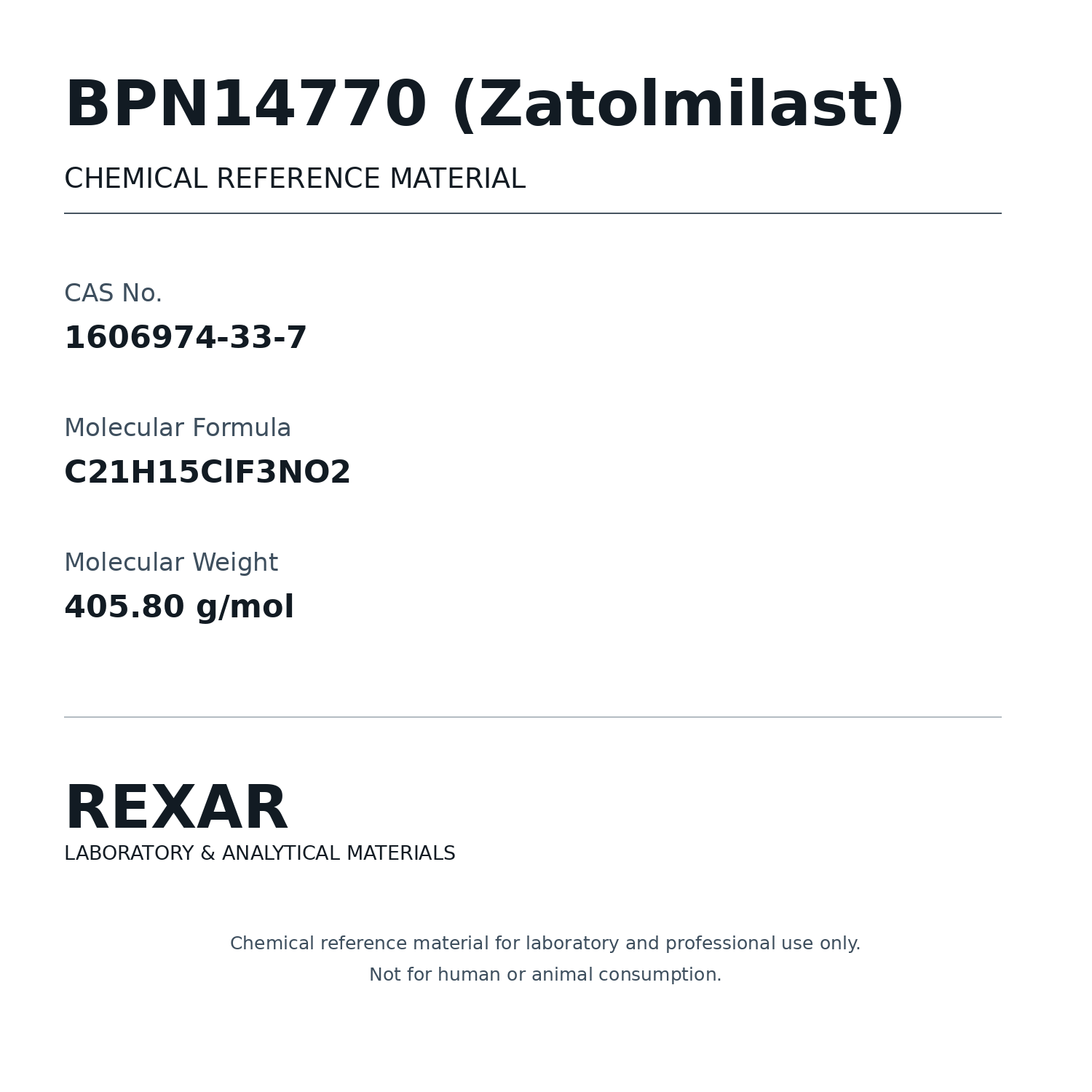
What is the CAS number of BPN14770?
The CAS number is 1606974-33-7.
What is the PubChem CID of BPN14770?
The PubChem compound identifier is 90111638.
What is the molecular formula of BPN14770?
The molecular formula is C21H15ClF3NO2.
What is the molecular weight of BPN14770?
The molecular weight is approximately 405.8 g/mol.
What is another name for BPN14770?
BPN14770 is also known as Zatolmilast and BPN-14770.
What type of chemical structure does BPN14770 contain?
BPN14770 contains a substituted pyridine framework combined with chlorinated, fluorinated and phenylacetic acid structural regions.
Does BPN14770 contain fluorine?
Yes. The molecular structure contains three fluorine atoms within a trifluoromethyl group.
Does BPN14770 contain chlorine?
Yes. The molecular structure contains one chlorine atom.
In which form is BPN14770 supplied?
It is supplied as a laboratory powder in sealed packaging.
Is this product intended for human or animal use?
No. This material is supplied exclusively as a laboratory reference compound.
Disclaimer:
This product is supplied exclusively as a chemical reference material for laboratory and analytical purposes. Not for human or animal consumption. Not intended for food, supplement, cosmetic, medical, diagnostic or therapeutic use.
| Intended use: | Laboratory research and analytical reference purposes only |
| Application area: | Analytical chemistry, reference comparison and method development |
| End user: | Professional users in controlled research environments |
| Regulatory classification: | Chemical reference material |