nl
Winkelwagen
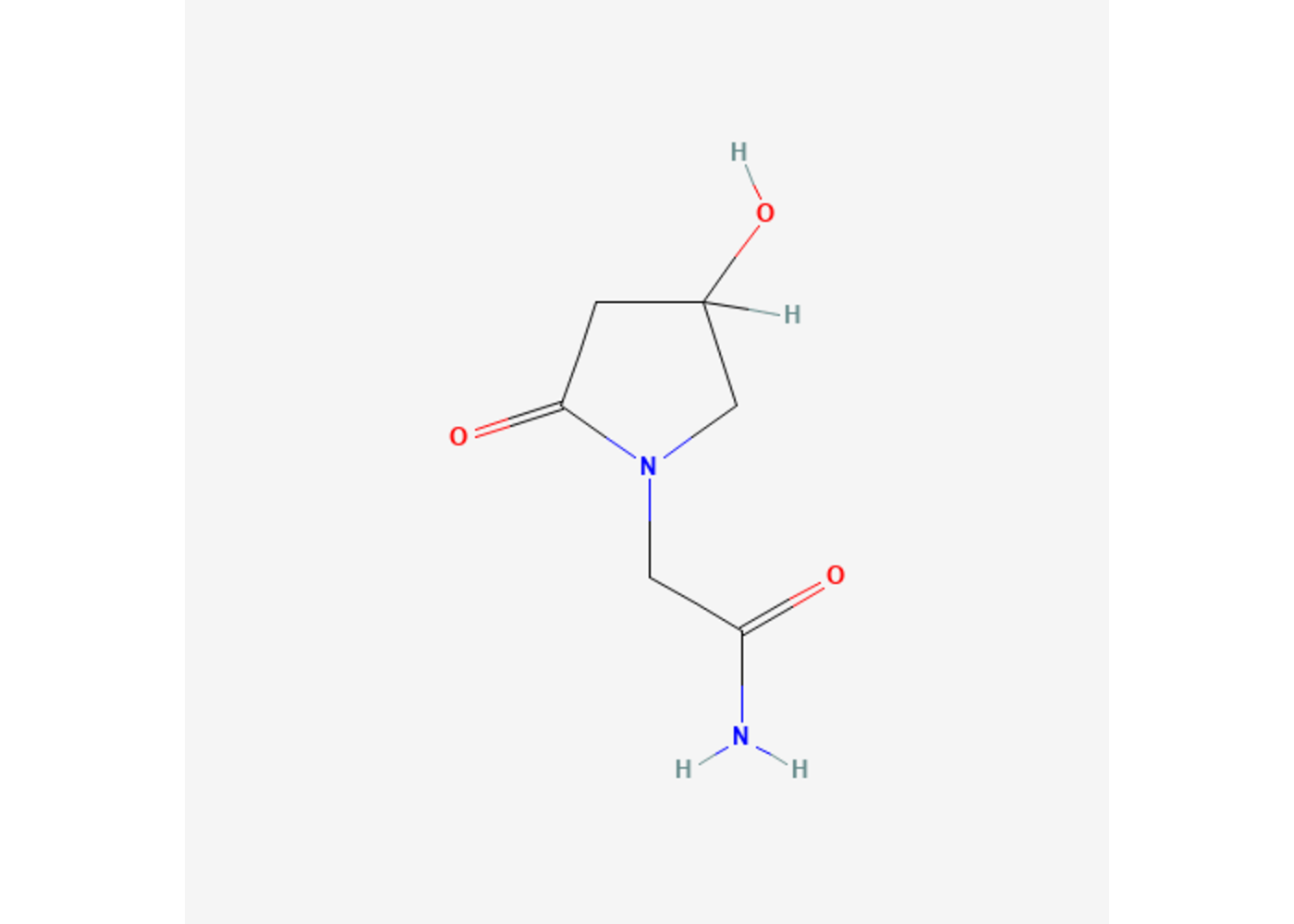
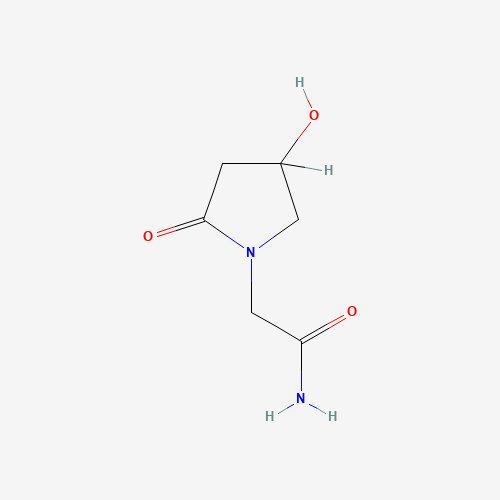

Oxiracetam (CAS 62613-82-5) is supplied by Rexar as a research-grade chemical reference material for analytical chemistry, structural verification and laboratory comparison workflows. This compound is provided exclusively for controlled research environments requiring confirmed chemical identity, reproducible analytical characteristics and consistent documentation standards.
Oxiracetam is available directly through the Rexar webshop and is supplied in sealed laboratory packaging for distribution within the European Union.
Rexar Technical Compound Datasheet (PDF)
Oxiracetam belongs to the racetam class of compounds characterised by a 2-pyrrolidone core structure. Structurally, it is defined as a hydroxyl-substituted derivative of the pyrrolidinone scaffold, combined with an acetamide side chain. The molecule contains both a cyclic amide (lactam) ring and a terminal amide functionality, resulting in a highly polar small-molecule framework.
The molecular architecture of Oxiracetam is comparatively compact, with a molecular formula of C6H10N2O3 and a molecular weight of 158.16 g/mol. The presence of multiple oxygen and nitrogen atoms contributes to defined hydrogen bonding potential and reproducible analytical behaviour.
Racetam derivatives share a common 2-oxo-pyrrolidine nucleus. Structural diversity within this class arises from substitution at the nitrogen atom or modification of side-chain groups attached to the lactam ring. Oxiracetam is distinguished by hydroxyl substitution at the 4-position of the pyrrolidone ring and by the presence of an acetamide moiety.
This substitution pattern modifies polarity, hydrogen bonding capacity and chromatographic behaviour while preserving the fundamental lactam core that defines racetam-type compounds.
Oxiracetam contains several functional groups relevant to structural analysis:
The lactam carbonyl and terminal amide carbonyl produce characteristic infrared absorption bands. The hydroxyl group may contribute broad O–H stretching signals in IR spectra, depending on hydrogen bonding conditions.
The pyrrolidin-2-one core exhibits resonance stabilisation between the nitrogen lone pair and the adjacent carbonyl group. This resonance imparts partial double-bond character to the C–N bond, restricting rotational freedom and contributing to molecular rigidity.
The secondary amide side chain similarly exhibits resonance behaviour, producing a planar amide bond geometry. These features influence NMR chemical shifts and IR absorption frequencies.
Due to the presence of both amide carbonyls and a hydroxyl group, Oxiracetam possesses multiple hydrogen bond donor and acceptor sites. In solid-state environments, intermolecular hydrogen bonding networks may contribute to crystal lattice stability.
In solution, hydrogen bonding interactions can influence solubility profiles and chromatographic retention behaviour.
The electron distribution within Oxiracetam reflects the combined influence of two carbonyl groups and a hydroxyl substituent. The overall molecular polarity is significantly higher than that of more hydrophobic racetam analogues.
This polarity contributes to defined retention behaviour in reversed-phase chromatographic systems and may result in shorter retention times relative to less polar derivatives under identical conditions.
NMR Spectroscopy: Proton NMR analysis typically reveals signals corresponding to the methylene groups adjacent to amide functionalities, along with signals influenced by hydroxyl substitution. Carbon-13 NMR differentiates carbonyl carbons, ring carbons and aliphatic carbons.
Infrared Spectroscopy: Characteristic absorption bands include amide carbonyl stretches and hydroxyl O–H stretching vibrations. The presence of two carbonyl groups allows clear identification of amide functionality.
Mass Spectrometry: Mass spectrometric analysis confirms the molecular weight of 158.16 g/mol. Fragmentation pathways may involve cleavage adjacent to amide bonds or dehydration processes under specific ionisation conditions.
Oxiracetam is typically encountered as a white crystalline powder. Crystalline small molecules containing amide and hydroxyl functionalities often display defined melting transitions and reproducible thermal behaviour.
Intermolecular hydrogen bonding within the crystal lattice may influence melting point and mechanical properties of the solid material.
The balanced presence of hydrogen bond donors and acceptors contributes to moderate aqueous solubility under laboratory conditions. Organic solvent compatibility may vary depending on solvent polarity and hydrogen bonding capacity.
Partition behaviour between aqueous and organic phases is influenced by the compound’s polarity and absence of strongly ionisable groups at neutral pH.
Retention modelling in reversed-phase systems may consider hydrophilicity, hydrogen bonding capacity and polar surface area. The presence of multiple polar functionalities typically results in predictable retention patterns.
Gradient optimisation and buffer selection can assist in resolving Oxiracetam from structurally related pyrrolidone derivatives during method development.
International chemical databases represent Oxiracetam using canonical SMILES strings and InChI identifiers. These digital descriptors encode atom connectivity and functional group placement in a machine-readable format, supporting laboratory information management systems (LIMS).
As a research-grade chemical reference material, Oxiracetam is supplied in sealed packaging to maintain stability during storage and transport. Batch identification labelling supports traceability and internal laboratory documentation.
What is the CAS number of Oxiracetam?
The CAS number of Oxiracetam is 62613-82-5.
In which form is Oxiracetam supplied?
This product is supplied as a white crystalline powder in sealed laboratory packaging.
Is this product intended for human or animal use?
No. This material is supplied exclusively as a laboratory reference compound.
Is Oxiracetam available for shipment within the EU?
Yes. Orders are supplied through the Rexar webshop in sealed laboratory packaging.
Oxiracetam possesses a compact molecular structure with limited conformational flexibility due to the presence of two amide bonds and a hydroxyl substituent. Amide bonds exhibit partial double-bond character, restricting rotation and contributing to defined molecular geometry.
The spatial orientation between the pyrrolidone ring and the acetamide side chain may influence intramolecular hydrogen bonding possibilities. While stable intramolecular hydrogen bonds are not necessarily dominant in solution, transient interactions may occur depending on solvent environment and temperature.
Although Oxiracetam predominantly exists in a stable lactam configuration, theoretical tautomeric equilibria may be considered within cyclic amide chemistry. Keto–enol tautomerism is generally unfavoured in simple lactam systems; however, conceptual evaluation of resonance contributors remains relevant in structural discussions.
The dominance of the amide form under standard laboratory conditions contributes to consistent spectroscopic behaviour and reproducible analytical identification.
The presence of hydroxyl and amide functional groups allows interaction with polar solvents through hydrogen bonding. In aqueous systems, hydration shells may form around polar sites, influencing dissolution rate and chromatographic performance.
Solvation dynamics may differ between protic and aprotic solvents. Hydrogen bond donor–acceptor balance plays a role in determining solvent compatibility and peak shape in liquid chromatography.
The thermodynamic stability of Oxiracetam under controlled laboratory conditions reflects the absence of highly reactive substituents. Amide bonds are generally resistant to spontaneous hydrolysis under neutral storage conditions.
Elevated temperatures or extreme pH environments may alter structural stability; therefore, standard storage recommendations support preservation of material integrity.
In the solid state, Oxiracetam molecules may arrange through hydrogen bonding between amide carbonyl oxygen atoms and hydroxyl groups. Such interactions can stabilise crystal packing and influence melting transitions.
The interplay between hydrogen bonding and van der Waals forces contributes to reproducible crystalline morphology in research-grade materials.
Compared to more hydrophobic racetam analogues, Oxiracetam demonstrates increased polarity due to its hydroxyl substitution and relatively low carbon count. This increased polarity can influence chromatographic retention and solvent partition behaviour.
Within reversed-phase systems, more polar derivatives generally elute earlier than aromatic-substituted analogues. Such comparative modelling assists in analytical differentiation within the racetam class.
Retention modelling may incorporate calculated polar surface area (PSA), hydrogen bond acceptor count and logP estimations. Oxiracetam’s structural features result in measurable contributions to polar surface area relative to other pyrrolidone derivatives.
Optimisation of mobile phase composition, gradient slope and buffer conditions enables precise separation in multi-compound analytical workflows.
Computational modelling of Oxiracetam may evaluate torsional angles between the acetamide chain and the lactam ring. Although amide resonance restricts rotation, minor conformational variations may exist around adjacent single bonds.
Such modelling contributes to understanding spectroscopic line broadening and subtle differences in NMR chemical shifts under varying conditions.
Reproducible crystalline form is essential for reference materials used in analytical comparison workflows. Defined melting behaviour and consistent particle morphology contribute to laboratory reliability.
Sealed packaging and controlled storage conditions minimise environmental exposure and preserve consistent analytical characteristics over time.
This product is intended for laboratory research use only. It is not intended for human or animal consumption, nor for medical, diagnostic or therapeutic applications. This compound is not intended to diagnose, treat, cure or prevent any disease.
| Intended use: | Laboratory research and analytical reference purposes only |
| Application area: | Analytical chemistry, reference comparison and method development |
| End user: | Professional users in controlled research environments |
| Regulatory classification: | Chemical reference material |