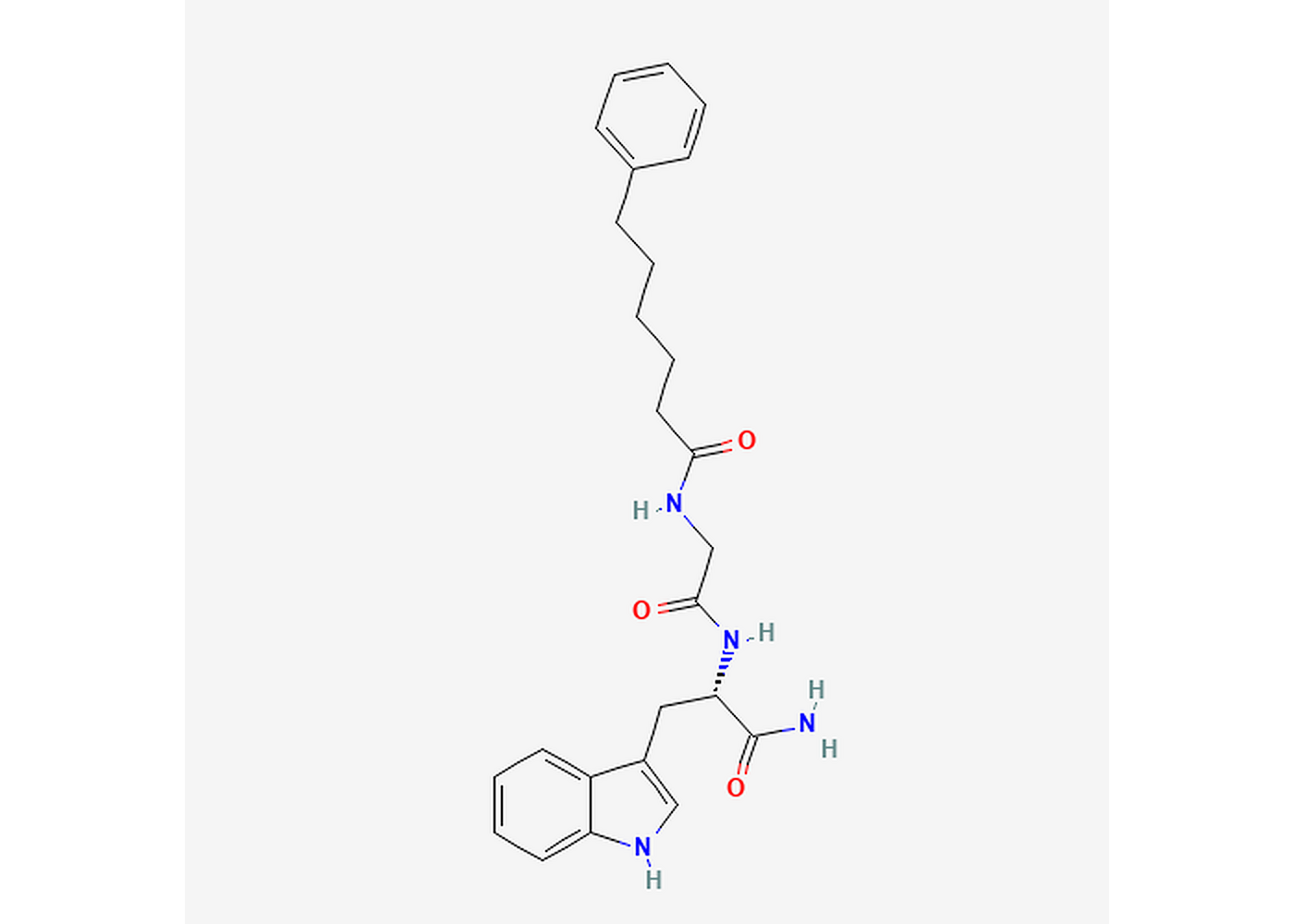
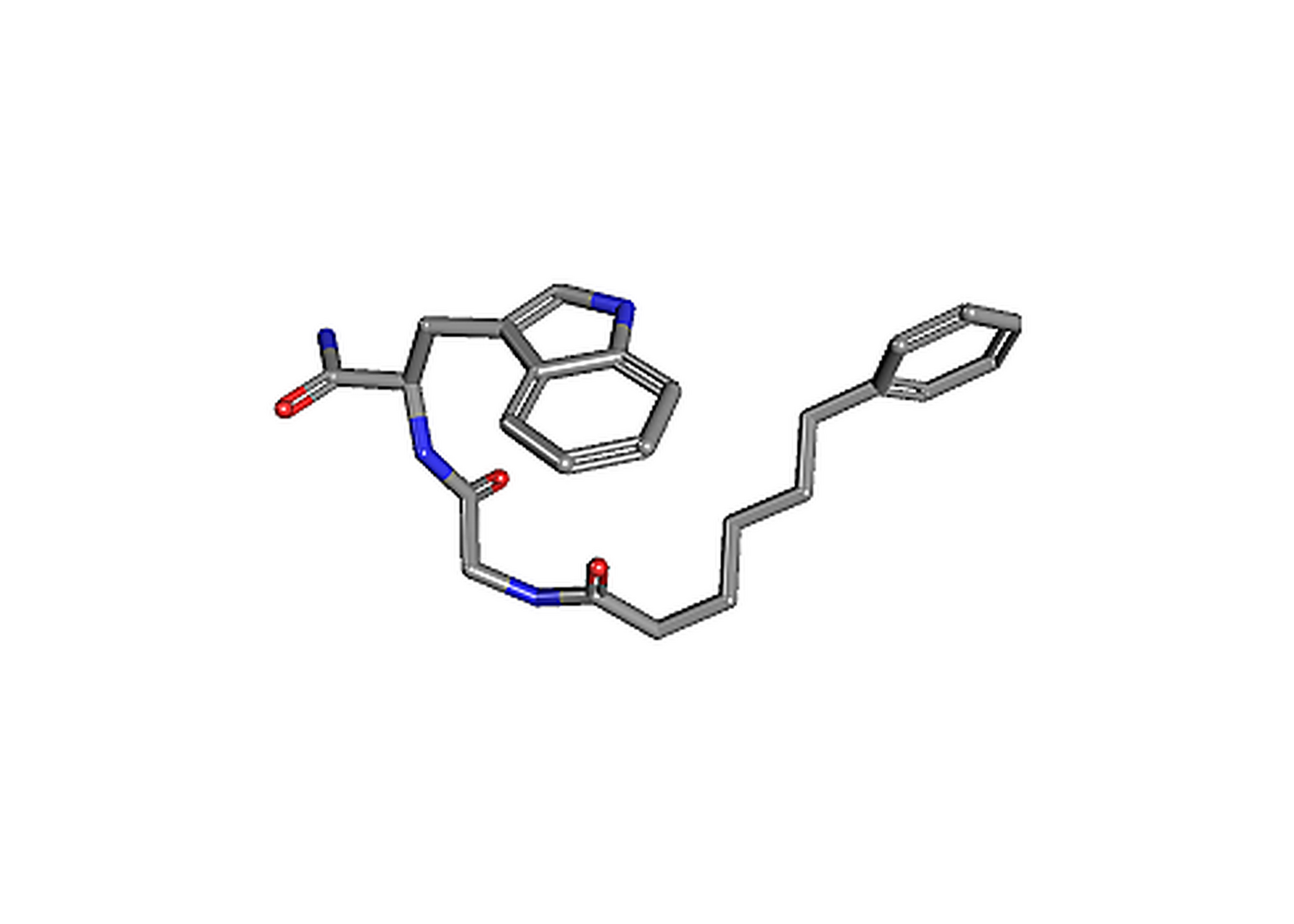
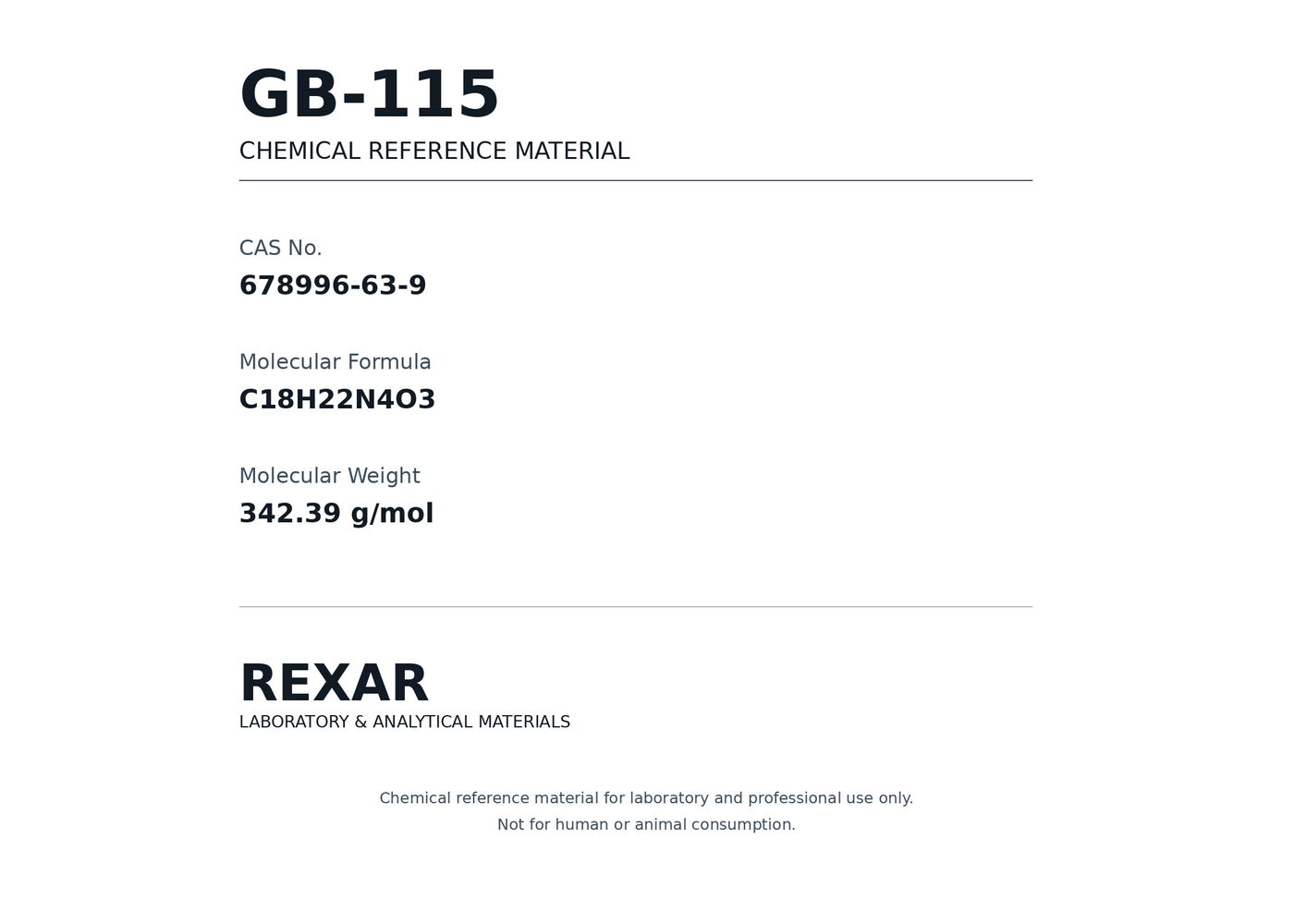
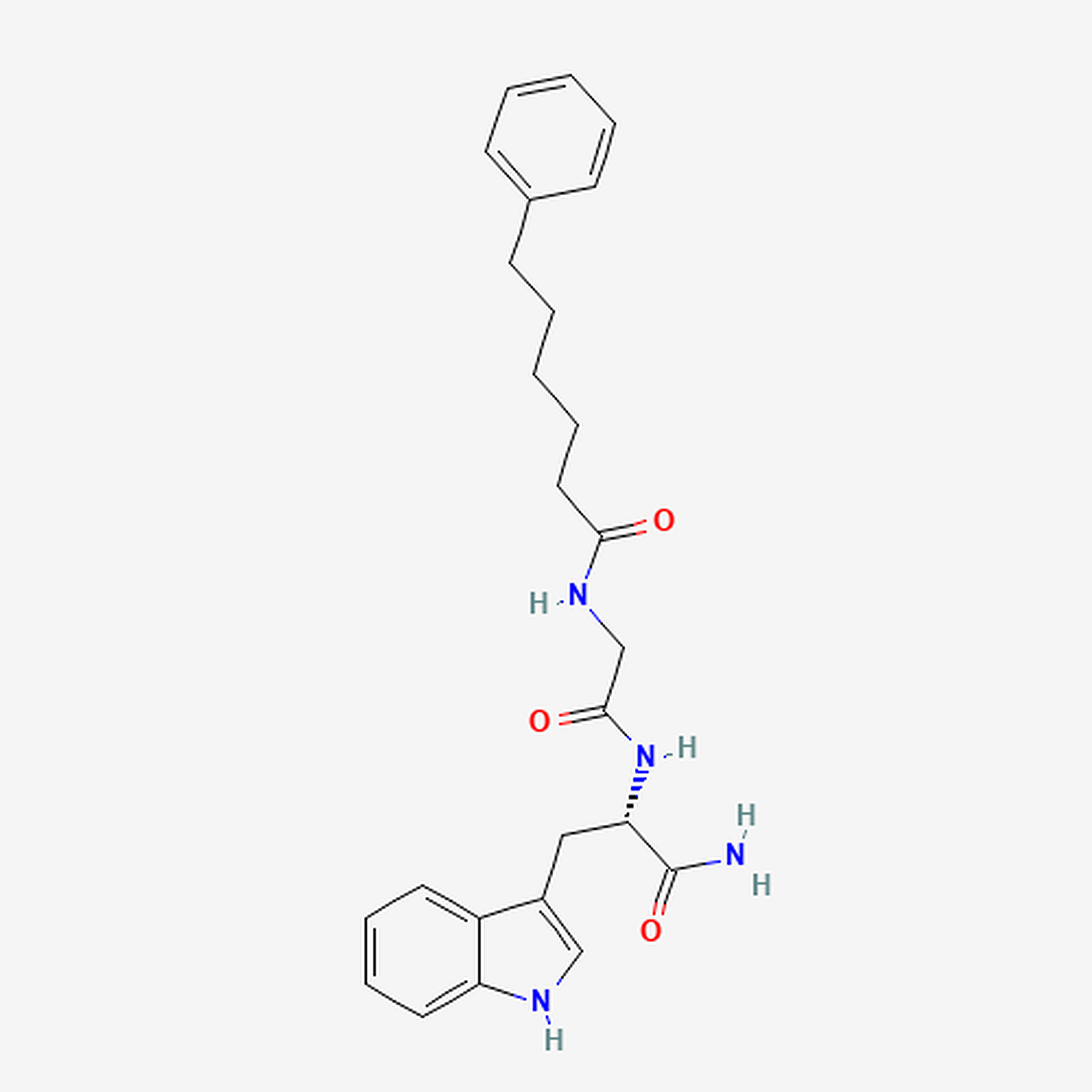

GB-115 is supplied by Rexar as a research-grade chemical reference material for analytical chemistry, compound identification and comparative laboratory workflows. Chemically identified as N-(1-oxo-6-phenylhexyl)glycyl-L-tryptophanamide, GB-115 combines an indole-containing tryptophanamide region, multiple amide functionalities, a glycyl linker and a terminal phenylalkyl chain. The material is supplied exclusively for controlled research environments requiring verified chemical identity, consistent structural documentation and reproducible analytical comparison.
Research-grade material distributed by Rexar within the European Union.
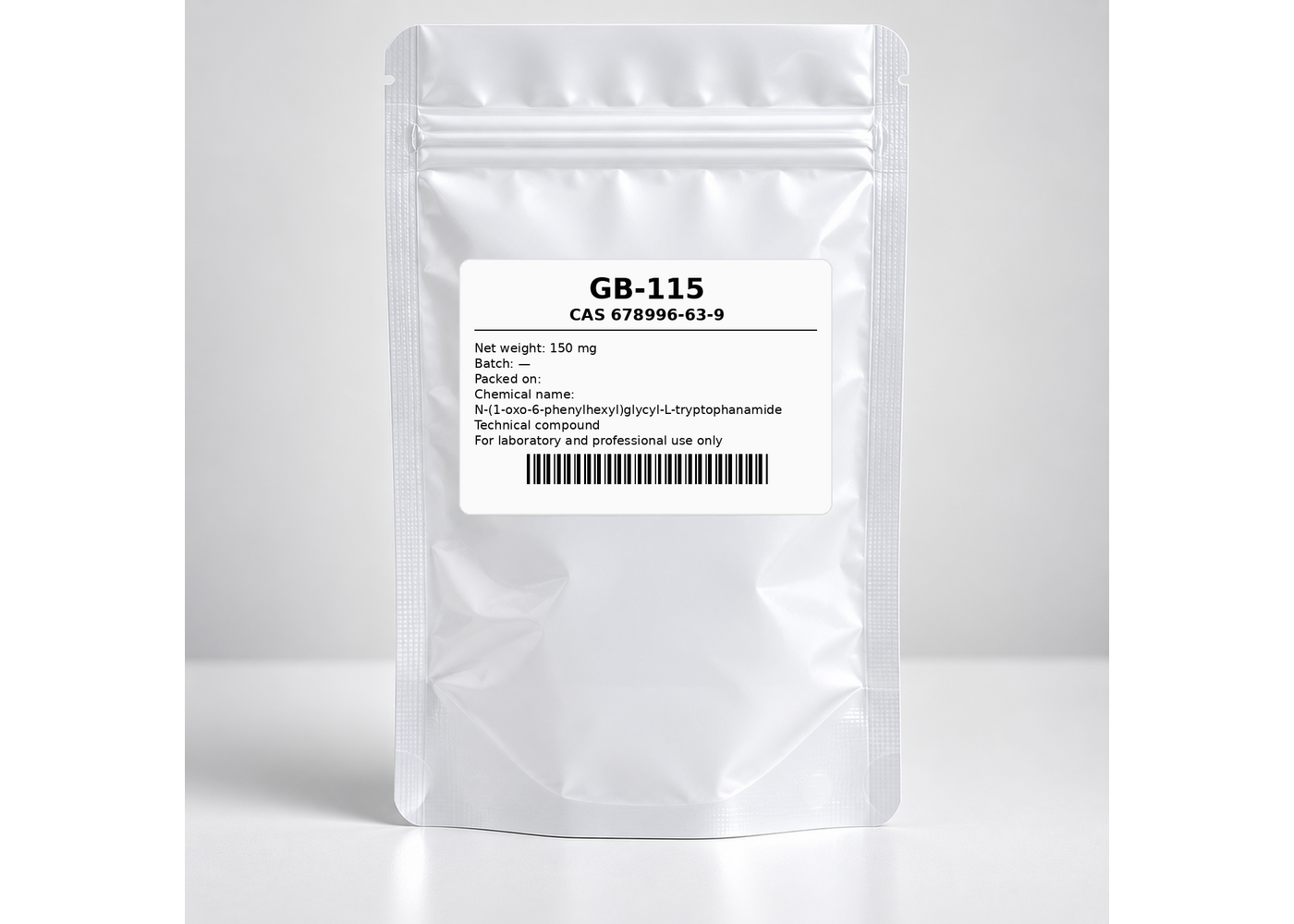
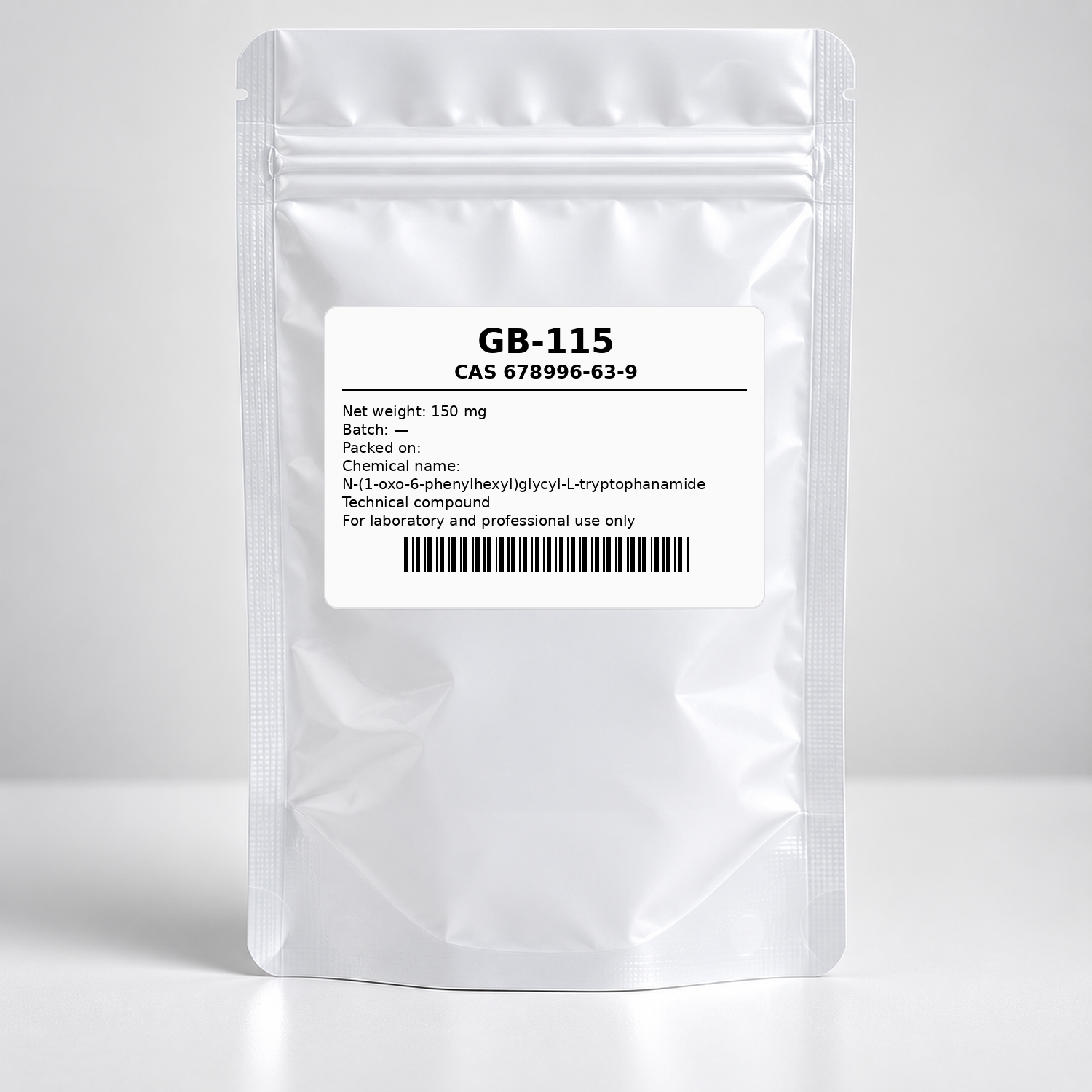
GB-115 (CAS 678996-63-9) is supplied in sealed laboratory packaging to support traceability, storage integrity and laboratory handling procedures.
Rexar Technical Compound Datasheet (PDF)
Molecular structure data and selected physicochemical properties can be consulted via: GB-115 on PubChem
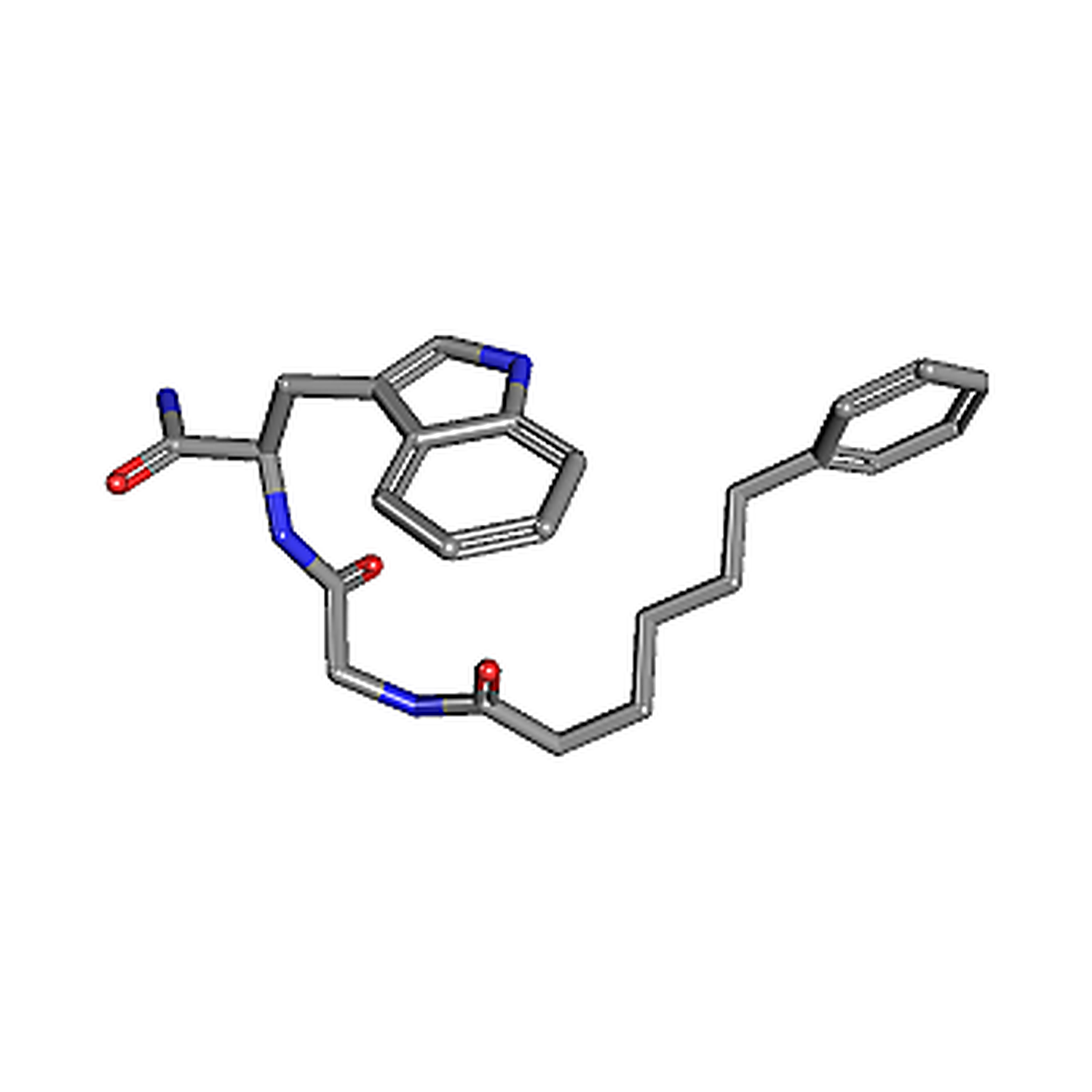
GB-115 is an organic amide compound with the molecular formula C25H30N4O3. Its molecular architecture contains an indole-containing tryptophanamide region connected through a peptide-like amide sequence to a phenyl-substituted aliphatic chain.
The structure contains four nitrogen atoms and three oxygen atoms distributed across an indole nitrogen, terminal carboxamide functionality and two additional amide environments. The combination of aromatic, heteroaromatic, amide and aliphatic structural regions provides multiple analytical markers suitable for chromatographic, mass-spectrometric and spectroscopic characterisation.
A defining structural feature of GB-115 is the presence of an indole ring system derived from the tryptophanamide portion of the molecule. This bicyclic heteroaromatic region combines a benzene ring with a nitrogen-containing five-membered ring.
The indole system provides an extended aromatic environment with characteristic proton and carbon resonances and may contribute strongly to ultraviolet absorption and chromatographic behaviour.
GB-115 contains a structural region related to L-tryptophanamide. This part of the molecule includes the indole side chain, a stereogenic carbon centre and a terminal carboxamide group.
The defined stereochemical configuration of this region forms an important component of the compound identity and distinguishes GB-115 from alternative stereoisomeric structures.
The molecular framework contains multiple amide functionalities connected in a peptide-like arrangement. These include the terminal tryptophanamide group and additional amide linkages connecting the central glycyl region to the phenylalkyl chain.
These amide functionalities contribute significantly to molecular polarity, hydrogen-bonding capacity and spectroscopic characteristics.
The molecular formula C25H30N4O3 reflects a structure containing carbon, hydrogen, nitrogen and oxygen distributed across several chemically distinct structural regions.
The combination of aromatic, heteroaromatic, amide and aliphatic structural elements provides multiple analytical markers for comparative compound identification.
GB-115 contains a terminal carboxamide group within the tryptophanamide portion of the structure. This functionality introduces both carbonyl and amino environments and contributes to local molecular polarity.
The carboxamide carbonyl may produce a characteristic infrared absorption feature and a distinguishable carbon resonance during carbon NMR analysis.
A central amide linkage connects the stereogenic tryptophanamide-derived region to the glycyl portion of the molecule. This structural feature contributes to the peptide-like organisation of GB-115.
The amide nitrogen and carbonyl oxygen provide characteristic hydrogen-bond donor and acceptor environments that may influence solubility, chromatographic retention and intermolecular interactions.
The central portion of GB-115 contains a glycyl-derived methylene region positioned between two carbonyl-containing amide functions.
This methylene environment may provide a characteristic proton and carbon NMR signal and forms a structurally useful marker for comparative identification.
GB-115 contains an extended aliphatic chain terminating in a phenyl ring. This phenylhexanoyl-type region contributes a relatively hydrophobic structural component to the molecule.
The aromatic phenyl ring and intervening methylene units provide distinguishable proton and carbon environments and contribute to chromatographic retention under reversed-phase conditions.
The molecule contains two chemically distinct aromatic regions: an indole system and a phenyl ring. These aromatic components are separated by amide and aliphatic structural elements.
This distribution creates multiple aromatic proton and carbon environments that can assist structural verification by NMR and spectroscopic comparison.
GB-115 contains four nitrogen atoms and three oxygen atoms occupying several distinct chemical environments. Nitrogen atoms are present within the indole ring, the terminal carboxamide and two additional amide functionalities.
The oxygen atoms are incorporated into three carbonyl groups. These heteroatom environments contribute to molecular polarity, hydrogen-bonding potential and characteristic infrared and NMR behaviour.
Multiple amide groups and the indole nitrogen provide several potential hydrogen-bond donor environments, while the carbonyl oxygen atoms provide hydrogen-bond acceptor sites.
This combination may influence solvent interactions, chromatographic behaviour, solid-state organisation and sample-preparation characteristics.
GB-115 combines polar peptide-like amide functionality with two substantial aromatic regions and an extended hydrocarbon chain. This creates a mixed molecular character involving both hydrophilic and hydrophobic structural features.
This balance is relevant when evaluating solvent selection, sample preparation and reversed-phase chromatographic conditions.
The GB-115 structure contains a defined stereogenic carbon centre within the tryptophanamide-derived region. Public registry information identifies the compound as the L-configured stereoisomer.
Stereochemical identity may be relevant during structural characterisation and comparison with authenticated reference material.
The indole and phenyl rings provide relatively rigid aromatic regions, while the amide linkages and extended aliphatic chain permit conformational flexibility between these components.
The combination of rigid aromatic regions and flexible aliphatic and amide linkages may influence chromatographic behaviour and solution-state conformation.
Under reversed-phase liquid chromatographic conditions, retention may be influenced by the indole ring, phenyl ring, aliphatic chain, amide functionalities and overall balance between hydrophobic and polar structural regions.
Retention time and peak shape may vary according to mobile-phase composition, gradient conditions, stationary-phase chemistry, temperature, pH and sample concentration.
LC-based methods may be used for qualitative identity comparison, purity profiling and retention-time verification of GB-115 reference material.
The combination of extended aromatic surface area, an aliphatic chain and multiple polar amide functions may require optimisation of mobile-phase composition and stationary-phase chemistry for suitable retention and peak symmetry.
With a molecular weight of approximately 434.5 g/mol, GB-115 falls within a mass range suitable for routine LC-MS analysis. Appropriate ionisation conditions may support detection of protonated, deprotonated or adduct-associated molecular species depending on solvent composition and instrument parameters.
Fragmentation may involve cleavage within the amide linkages, glycyl region, tryptophanamide-derived portion or phenylalkyl segment and may support structural confirmation when compared with authenticated reference data.
Proton NMR analysis may show characteristic resonances associated with the indole system, phenyl ring, stereogenic methine environment, glycyl methylene group, extended aliphatic chain and amide-associated proton environments.
Carbon NMR analysis may provide distinguishable signals corresponding to aromatic carbons, indole carbons, carbonyl carbons, methylene carbons and the stereogenic carbon environment.
Infrared analysis may reveal characteristic absorption features associated with multiple amide carbonyl groups, N-H environments, aromatic C-H bonds and aliphatic C-H bonds.
The presence of three carbonyl-containing amide functionalities may provide prominent absorption features suitable for comparative structural characterisation.
The indole and phenyl aromatic systems of GB-115 may support ultraviolet-based chromatographic detection. Suitable detection wavelengths should be selected according to measured absorbance characteristics and validated laboratory methods.
The indole system in particular is expected to contribute substantially to the electronic absorption profile of the compound.
The indole ring represents a major heteroaromatic chromophore within GB-115. Its fused aromatic architecture can produce characteristic ultraviolet absorption and spectroscopic behaviour under appropriate analytical conditions.
Combined with the second phenyl ring, the indole region provides multiple optical and structural markers for comparative analytical identification.
GB-115 contains three carbonyl groups associated with amide functionalities positioned in chemically distinct regions of the molecule.
These carbonyl environments may produce separate or overlapping spectroscopic features depending on solvent, conformation and analytical conditions and can support structural comparison through IR and carbon NMR methods.
The phenyl-containing portion of GB-115 includes an extended sequence of methylene units connecting the terminal aromatic ring to the amide carbonyl region.
These methylene environments introduce conformational flexibility and provide multiple aliphatic proton and carbon signals that may assist NMR-based structural assignment.
GB-115 is supplied as a laboratory solid. Solid-state characteristics such as crystallinity, particle morphology, residual moisture and residual solvent content may depend on manufacturing and purification procedures.
Analytical laboratories may use thermal behaviour, powder analysis or spectroscopic comparison as supplementary identity indicators where appropriate.
GB-115 may serve as a qualitative reference compound in structural verification and comparative analytical workflows involving LC-MS, HPLC, NMR and infrared spectroscopy. Laboratory procedures may include retention-time comparison, molecular-weight confirmation and comparative spectral profiling.
GB-115 can be structurally classified as a tryptophanamide-derived peptide-like compound containing an indole ring, multiple amide functionalities and a phenyl-substituted aliphatic chain.
Its molecular framework provides a distinctive mixed aromatic-amide architecture for comparative analytical workflows involving indole-containing compounds, peptide-like reference materials and structurally related amide compounds.
The indole ring is attached to the stereogenic carbon-containing tryptophanamide region through a methylene group. This arrangement is characteristic of the tryptophan-derived portion of the molecule.
The indole proton and carbon environments provide useful structural markers for NMR and ultraviolet-based analytical comparison.
The second aromatic region consists of an unsubstituted phenyl ring positioned at the terminal end of an extended aliphatic chain.
This arrangement creates a distinct aromatic environment separate from the indole system and provides additional proton and carbon resonances useful for structural verification.
The central portion of GB-115 contains a sequence of carbonyl, nitrogen and methylene environments resembling short peptide connectivity.
This organisation provides characteristic amide bonds and carbonyl environments that may be evaluated using LC-MS, NMR and infrared analytical methods.
The three carbonyl groups in GB-115 occupy distinct amide environments. Their chemical shifts and vibrational characteristics may differ according to neighbouring structural groups and molecular conformation.
These carbonyl environments represent important analytical markers for comparison with authenticated reference data.
The multiple amide functionalities and indole nitrogen may influence ionisation behaviour under different analytical conditions. Protonation and adduct formation may depend on solvent composition, mobile-phase additives and ionisation parameters.
Instrument settings and sample-preparation conditions should therefore be optimised according to validated laboratory procedures.
The molecular formula C25H30N4O3 contains four nitrogen atoms distributed across the indole and amide-containing regions and three oxygen atoms present as carbonyl oxygen atoms.
The theoretical elemental composition can support identity verification when combined with accurate-mass spectrometry and spectroscopic analysis.
As a chemical reference material, GB-115 may be used for qualitative structural comparison, method development and analytical identity verification in laboratories examining indole-containing amides, peptide-like compounds, aromatic amides or related reference materials.
Analytical reproducibility depends on consistent sample preparation, validated instrument parameters, suitable reference documentation and controlled storage conditions.
Each unit is supplied in sealed laboratory packaging designed to support material integrity during storage and transport. Batch identification labelling supports traceability and internal documentation within controlled research environments.
Packaging should remain closed when the material is not in use and should be protected from moisture, excessive heat and direct light.
What is the CAS number of GB-115?
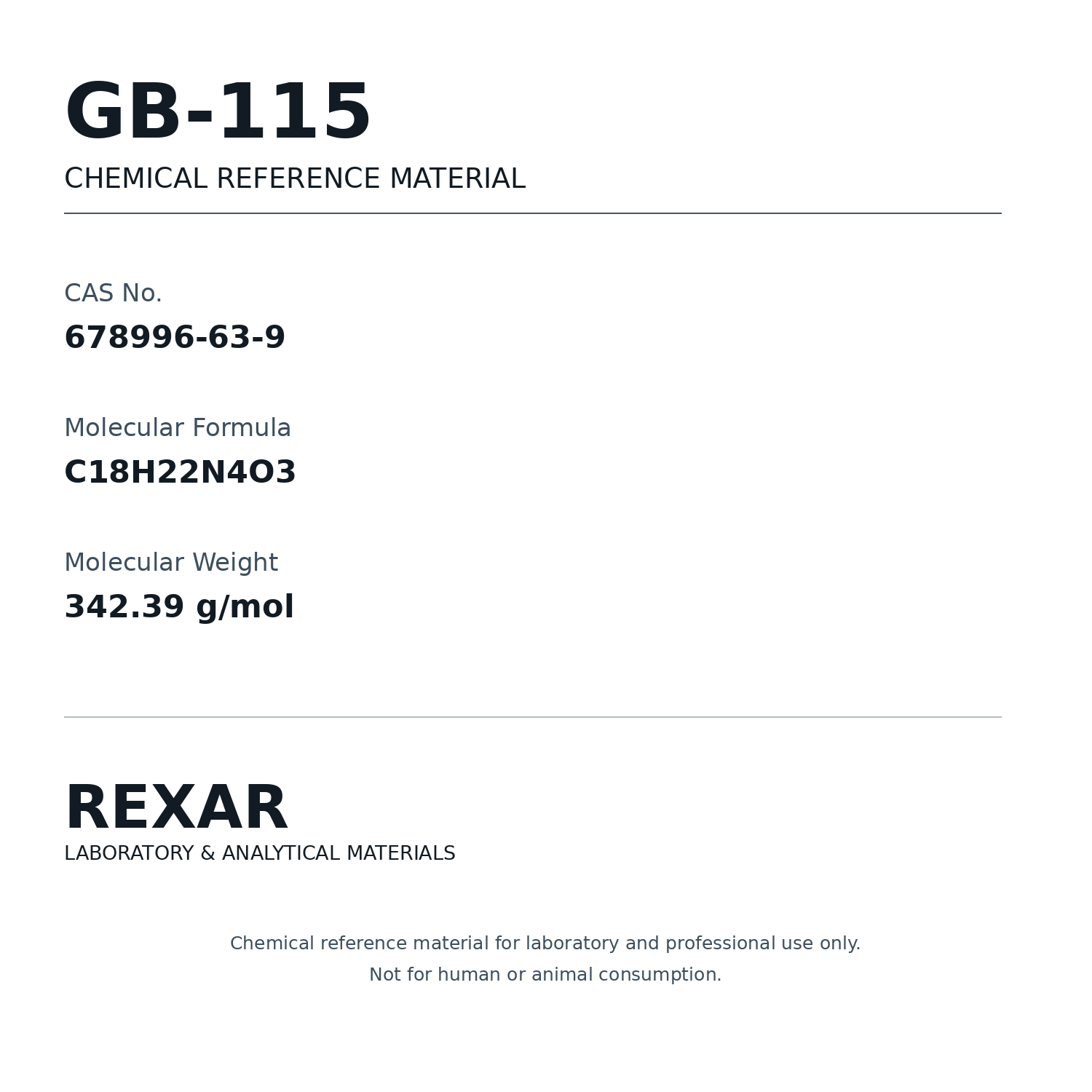
The CAS number is 678996-63-9.
What is the PubChem CID of GB-115?
The PubChem compound identifier is 11281948.
What is the molecular formula of GB-115?
The molecular formula is C25H30N4O3.
What is the molecular weight of GB-115?
The molecular weight is approximately 434.5 g/mol.
What is the chemical name of GB-115?
A recognised chemical name is N-(1-oxo-6-phenylhexyl)glycyl-L-tryptophanamide.
What structural class does GB-115 belong to?
GB-115 is a tryptophanamide-derived, peptide-like amide compound containing indole and phenyl aromatic regions.
How many nitrogen atoms does GB-115 contain?
The molecular structure contains four nitrogen atoms.
How many oxygen atoms does GB-115 contain?
The molecular structure contains three oxygen atoms.
Does GB-115 contain a defined stereocentre?
Yes. The registered GB-115 structure contains a defined stereogenic centre within its L-tryptophanamide-derived region.
In which form is GB-115 supplied?
It is supplied as a laboratory solid in sealed packaging.
Is this product intended for human or animal use?
No. This material is supplied exclusively as a laboratory reference compound.
Disclaimer:
This product is supplied exclusively as a chemical reference material for laboratory and analytical purposes. Not for human or animal consumption. Not intended for food, supplement, cosmetic, medical, diagnostic or therapeutic use.
| Intended use: | Laboratory research and analytical reference purposes only |
| Application area: | Analytical chemistry, reference comparison and method development |
| End user: | Professional users in controlled research environments |
| Regulatory classification: | Chemical reference material |